


Location: You are an FY1 on medical ward cover. The ward sister has bleeped you to see a patient
Patient: 55 year old man has developed central crushing chest pain
Task:
– Take a focused history from the patient
– Perform a full ABCDE assessment, a nurse will be available to help you with investigations or management that you require.
– After 6 minutes you will be asked a series of questions by the examiner.
– Answer any questions that the patient may have
Note to actor: Try to restrain yourself from volunteering to much information – you may do so when prompted (that is, by a specific question, not a general one). If a student is on the wrong line of clinical reasoning do not fuel this line of thinking, state no to the question, as being ambiguous may prompt further questioning and does not allow the student to be appropriately tested. The aim of the exercise is to take a focused history; short answers are required.
Central crushing chest pain came on 1 hour ago. Pain is a 10/10, radiates to jaw and left shoulder. You have not experienced anything like this before. You feel sweaty and terrible like you are going to die. You have vomited once and feel incredibly nauseous.
PMH = hypertension, type 1 diabetes
DH = novorapid, levemir insulin
No known drug allergies
| Mark sheet | 😊 | 😃 |
|---|---|---|
| Candidate appropriately introduced themselves with: | 3 | 4 |
| History | 2 | 4 |
| Airway assessment | 1 | 2 |
| Breathing assessment | 3 | 5 |
| Breathing investigations | 1 | 2 |
| Breathing treatment | 1 | |
| Circulation assessment | 3 | 5 |
| Circulation investigations | 2 | 3 |
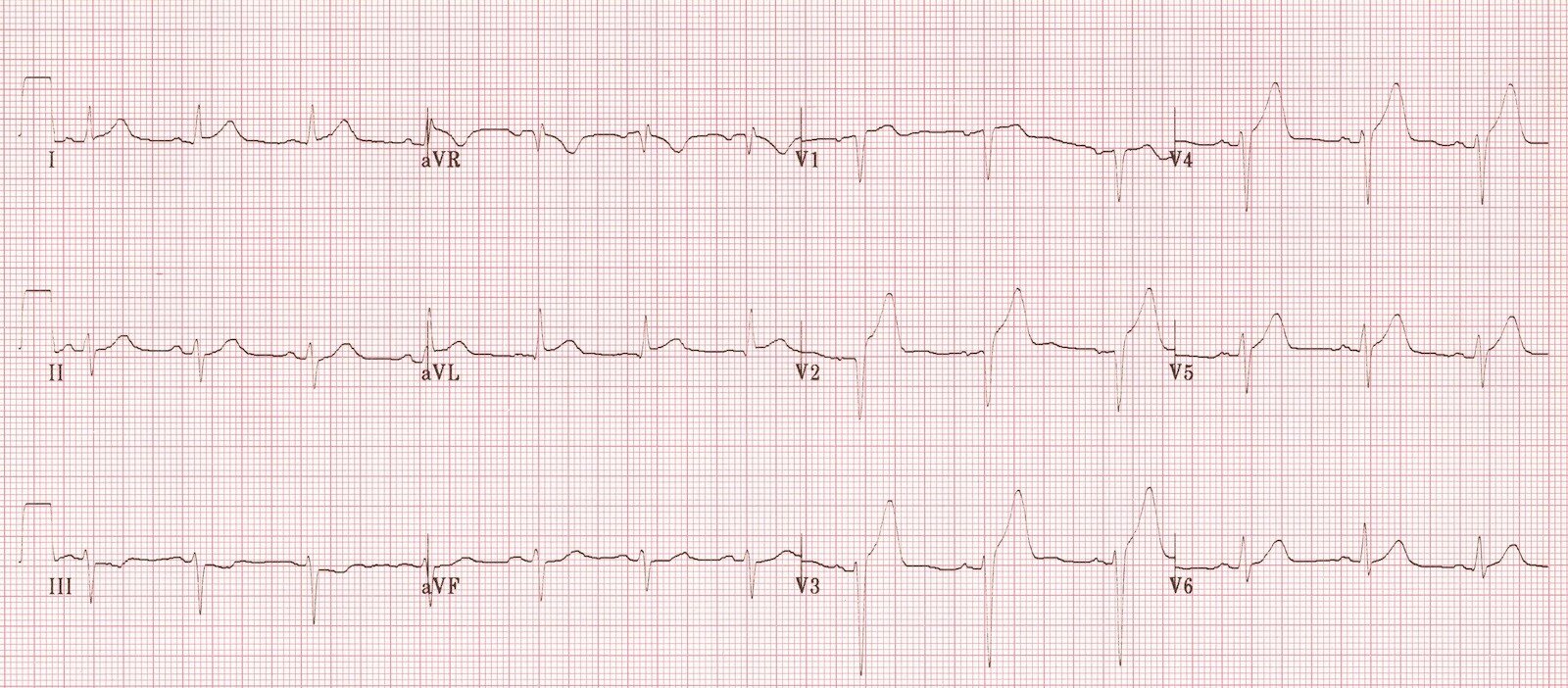 ECG interpretation |
2 | 3 |
| Diagnosis | 1 | |
| STEMI treatment | 4 | 6 |
| Circulation treatment | 1 | |
| Disability assessment | 2 | 4 |
| Exposure | 1 | |
| Escalation | 1 | |
| Reassessment | 1 |
Your percentage: 0%
Pass
Fail
Your percentage
Average user score for this station
Station pass mark
Feedback
Recognise a time-critical coronary syndrome
- Central crushing pain lasting an hour, radiating to the jaw and left shoulder, with sweating, vomiting and severe distress strongly suggests acute myocardial infarction. Hypertension and type 1 diabetes increase cardiovascular risk. Take a focused history while assessment and treatment proceed, rather than completing a lengthy history first.
- This patient is physiologically unstable: oxygen saturation is 89% on air, respiratory rate 30/min and blood pressure 90/55 mmHg. Hypotension raises concern for developing cardiogenic shock, even with a capillary refill below two seconds. Seek senior medical help and activate the emergency cardiology/primary PCI pathway immediately.
- Briefly screen for important alternatives: abrupt pain maximal at onset, radiation to the back or neurological symptoms suggest aortic dissection; pleuritic pain, haemoptysis and thromboembolic risk factors suggest pulmonary embolism. These distinctions matter because treatment differs substantially.
Interpret the ECG in context
- The supplied ECG shows marked ST elevation across the anterior precordial leads, most striking in V2–V4, with tall, broad T waves merging into the elevated ST segments. There are QS complexes/poor R-wave progression in the septal leads, particularly V1–V2. In this clinical context, this supports an acute anterior/anteroseptal STEMI, usually involving the left anterior descending coronary artery territory.
- Hyperacute T waves reflect acute ischaemia, while septal Q/QS changes suggest evolving infarction. Q waves do not mean that reperfusion is no longer worthwhile. The symptoms and diagnostic ECG require immediate action; do not wait for troponin results.
Stabilise using ABCDE
- Assess and treat in parallel, using the nurse to obtain monitoring, intravenous access and investigations. A talking patient has a patent airway, but the hypoxaemia needs immediate oxygen: initially use a reservoir mask, then titrate to an appropriate saturation target, usually 94–98% unless there is a risk of hypercapnic respiratory failure. An ABG helps assess oxygenation, ventilation and acidosis; chest imaging can identify pulmonary oedema or another thoracic cause without delaying reperfusion.
- Establish two intravenous cannulae, continuous cardiac monitoring and frequent blood pressure measurements. Send bloods including troponin, full blood count, renal function and electrolytes. Check bedside glucose promptly because he uses insulin; arrange ongoing glucose monitoring and an appropriate inpatient insulin plan.
- Hypotension requires careful reassessment, not an automatic large fluid load. Assess for congestion and discuss a cautious crystalloid challenge with senior support if appropriate, reassessing blood pressure, oxygenation and lung signs after each step. Left ventricular failure may worsen with fluids; persistent hypotension may require critical care support.
Treat the infarction and restore coronary flow
- Give aspirin 300 mg orally, chewed if possible, after checking allergy and relevant contraindications. Additional P2Y12 inhibition and anticoagulation should follow the cardiology-led reperfusion pathway: drug selection depends on the intended intervention, bleeding risk and renal function. Fondaparinux is not adequate as the sole anticoagulant during primary PCI.
- Treat severe pain with carefully titrated intravenous opioid analgesia and an antiemetic, monitoring blood pressure, consciousness and respiration. Withhold GTN at this blood pressure because further vasodilatation could worsen hypotension.
- Primary PCI is the preferred reperfusion strategy when it can be delivered promptly. If it cannot, urgent specialist assessment determines whether fibrinolysis is appropriate under the local pathway, including contraindication checks. Explain simply: “The ECG suggests a heart attack caused by a blocked artery; we are arranging urgent treatment to restore blood flow.”
Reassess and anticipate deterioration
- Repeat ABCDE after interventions and monitor pain, oxygen requirement, respiratory rate, blood pressure, rhythm, mental state and urine output. Improvement should include reduced pain and ST elevation, better oxygenation and stable perfusion; pain relief alone does not prove that the artery has reopened.
- Persistent or recurrent pain, ongoing ST elevation, worsening hypotension, new pulmonary oedema, significant arrhythmia or reduced consciousness require immediate escalation. A new murmur with deterioration raises concern for a mechanical complication. Keep resuscitation equipment readily available while definitive treatment is arranged.
Previously completed stations
| Score | Date |
|---|---|
| 0% | 19 Oct 2026 |
| 12% | 6 Oct 2026 |